
This is the first decline since June this year when car sales declined by 11%.

According to the Trends and Progress Report of the RBI, 98 per cent of frauds in terms of value were related to loans, and their occurrence was spread over several previous years.

Naukri.com's Hiring Outlook Survey for 2020 reveals the jobs and sectors that saw a surge in demand during the pandemic.

Banks operating in India reported fraud of Rs 4.92 trillion as on March 31, 2021, which represents nearly 4.5 per cent of the total bank credit, showed Reserve Bank of India (RBI) data, which was sought under the Right to Information (RTI) Act by Saurabh Pandhare. The data showed 90 banks and financial institutions reported a total of 45,613 cases of loan fraud till March 31, 2021. State Bank of India - the country's largest lender - reported the highest amount of loans as fraud - Rs 78,072 crore as on March 31, 2021.
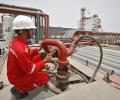
The country's exports declined marginally by 0.8 per cent to $26.89 billion in December 2020, due to contraction in sectors like petroleum, leather and marine products, according to preliminary data released by the commerce ministry on Saturday. The trade deficit in December widened to $15.71 billion, as imports grew by 7.6 per cent to $42.6 billion, the data showed. Export in December 2019 was $27.11 billion, while imports stood at $39.5 billion.

On the Sensex chart, NTPC, SBI, UltraTech Cement, ICICI Bank, Tata Steel, Bajaj Finserv and Bjaja Finance were among the major laggards, shedding as much as 1.63 per cent.

'...to come back to power because it was not doing well.'

India's crude oil production fell 2.3 per cent in August but natural gas output rose by more than a fifth on the back of output from KG-D6 fields of Reliance-BP, government data released on Wednesday showed. Crude oil production dropped to 2.51 million tonnes in August as output from fields operated by state-owned Oil and Natural Gas Corp (ONGC) dipped. India is 85 per cent dependent on imports to meet its oil needs and the government has been for long looking at ways to raise the domestic output so as to reduce import dependence.

Non-core sponge iron plants, petrochemicals units and oil refineries have cornered as much as 13.13 million cubic metres per day out of the 60.76 mmscmd of KG-D6 gas allocated.

Investor wealth slumped by a whopping Rs 5.3 lakh crore on Friday as the benchmark BSE Sensex crashed more than 1,900 points to post its biggest single-day fall in nearly ten months. At the close of trade, the total market capitalisation of BSE-listed companies eroded by Rs 5,37,375.94 crore to Rs 2,00,81,095.73 crore. The total market capitalisation of these companies stood at Rs 2,06,18,471.67 crore on February 25.

The economy can't grow without increasing electrification, which requires more power plants, and given coal is the cheapest form of fuel and is abundant, it makes sense that India is looking to boost the use of the fuel.

Since October, FPIs have sold over $26 billion worth of stocks, which is the largest selling ever seen in India, observes Akash Prakash.
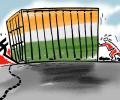
India's merchandise exports jumped 27.16 per cent to $30.04 billion in November on the back of good performance by sectors like petroleum products, engineering goods and electronic items, official data showed on Tuesday. The exports stood at $23.62 billion in November 2020. Imports in November were at $52.94 billion, showing an increase of 56.58 per cent over inbound shipments of $33.81 billion in the year-ago month.

ONGC was the top loser in the Sensex pack, shedding around 5 per cent, followed by SBI, Axis Bank, ICICI Bank, Bajaj Auto and Maruti. On the other hand, IndusInd Bank, HUL, Dr Reddy's, NTPC and Reliance Industries were among the gainers.
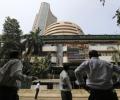
NTPC was the top gainer in the Sensex pack, rallying nearly 6 per cent, followed by ICICI Bank, Titan, L&T, SBI, Sun Pharma and Nestle India. On the other hand, HCL Tech, Kotak Bank, Tech Mahindra, Hero MotoCorp and Infosys were among the laggards.

Equities went into a tailspin on Wednesday after the Reserve Bank surprised the market with a mid-cycle rate hike in a bid to tame soaring inflation.

The Organization of Petroleum Exporting Countries (OPEC) in its latest monthly oil market report projected the world's third-biggest energy consumer to add 0.39 million barrels per day (bpd) of crude oil demand in 2022. India's oil demand rose from 4.51 million barrels per day in 2020 to 4.76 million bpd in 2021, recording a 5.61 per cent growth.
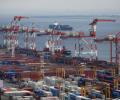
Barring rice, spices, iron ore and pharmaceuticals, all the remaining 26 key sectors registered negative growth in May. Imports too plunged 51 per cent to $22.2 billion in May.

Of these 8.5 million additional people employed in September, 6.5 million were in rural India, reveals Mahesh Vyas.

TCS was the top gainer in the Sensex pack, rising around 4 per cent, followed by ONGC, ICICI Bank, HDFC Bank, Dr Reddy's, HDFC and HCL Tech. NSE Nifty advanced 76.65 points to 14,581.45.

Eighteen months after the economy was battered by the Covid-induced lockdown, employment has not recovered to its pre-pandemic levels, points out Mahesh Vyas.
The Netherlands has emerged as India's fifth-largest export destination in 2021-22 (FY22), jumping from its 10th position a year ago. Exports to the fifth-largest economy in the European Union (EU) bolted 94 per cent to $12.5 billion in the financial year ended March 31. In FY22, the Netherlands surpassed Hong Kong, Singapore, the UK, Germany, and Nepal to become India's largest export destination in the EU. Germany, which was earlier India's top European export destination (eighth position), has now dropped two ranks to 10th place.

He is the fourth leader of the Sharad Pawar-led Nationalist Congress Party, which is ruling in alliance with the Shiv Sena and Congress in Maharashtra, to face the heat from the central agency.

In the past 12 months, since September 2020, the net cumulative increase in employment has been just 44,483. This is negligible -- just 0.04 million on a base of over 400 million jobs, reveals Mahesh Vyas.

But their trajectory and direction have been largely influenced by politics and the political leadership's understanding of how the economy needs to be managed, explains A K Bhattacharya.

Outflows are likely to continue, experts say, till such time as the markets see a significant correction.

More than 6 crore doses of COVID-19 vaccine have been sent to 76 nations, while 4.5 crore doses have been administered to beneficiaries in the country till now, Union Health Minister Harsh Vardhan said.

The unexpected interest rate hike by the RBI on Wednesday will have the banking system on average making a 10-15 bps gains on the yields, with private banks making larger gains as 57 per cent of their loans are linked to external benchmark rate and 40 per cent to the marginal cost of lending rates, as per a report. Stating that lenders and borrowers will face volatile times with the Reserve Bank raising the repo rate by 40 bps to 4.40 per cent and the cash reserve ratio (CRR) by 50 bps on May 4 in an off-cycle policy move, India Ratings said the market rates had already been moving higher before the move. The 364-day T-bills have moved up 120 bps and 10-year G-sec by 140 bps since May 2020, when the repo rate was cut to a record 4 per cent, which led to an expectation of a faster and sharper rise in interest rates in the system but the central bank stayed the course to support the fragile economy battered by the pandemic.

Imports too tumbled by 58.65 per cent to $17.12 billion in April from $41.4 billion in the same month last year, according to the data by the commerce and industry ministry.
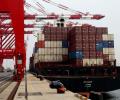
Imports too contracted by 28.72 per cent to $31.16 billion. Dip in exports and imports narrowed the trade deficit -- the difference between imports and exports -- in March to $9.76 billion, the lowest in the last 13 months.

Not all public sector banks are back in the black, but their collective net profit for the year is Rs 32,346 crore against a Rs 9,013 crore loss in the previous year, points out Tamal Bandyopadhyay.

The Saveetha Institute of Medical and Technical Sciences. The Indian School of Mines, Dhanbad. Vinay Umarji explains why these two universities have made India proud.

Though COVID-19 will wreak more damage to the finances of the Indian population, the insurance sector is unlikely to get hurt.

Dr Reddy's was the top gainer in the Sensex pack, rising over 3 per cent, followed by PowerGrid, TCS, HCL Tech, Infosys and Reliance Industries. On the other hand, L&T, IndusInd Bank, Bajaj Finserv and Bharti Airtel were among the laggards.

India has come a long way from conducting the first COVID-19 test in January in a laboratory in Pune to crossing the milestone of conducting four crore such tests.

After selling dollars for the past few months, the Reserve Bank of India (RBI) may take a hands-off approach before its annual account closing by not trying to prop up the rupee as geopolitical tensions show signs of stabilising with global crude oil prices easing from its $140 peak. The central bank was a net buyer of dollars between April and September, and then turned a net seller in the following months, the data released by the RBI showed. The RBI continued to be a net buyer of $36.6 billion in this fiscal year - between April and January. In 2020-21, it purchased $68 billion on a net basis.

India economy clocked a five-year high growth rate of 7.6 per cent in 2015-16.

On the Sensex chart, IndusInd Bank, SBI, Dr Reddy's, NTPC, ICICI Bank, HCL Tech and Bajaj FinServ emerged as major laggards.

Is the worst over for Indian banks? The past two years saw them ride on treasury trades as deposits soared and credit growth dipped sharply. Gross and net non-performing assets (NPAs) moved south, and the provision coverage ratio (PCR), capital buffers, and profitability indicators are back at pre-pandemic levels. So, what's the plot ahead?

@015 may be a good year for FMCG firms.
